Support the mission
Fund the work that makes these wrecks safe
Eighty years of corrosion don't pause for funding cycles. Sponsors and foundations put survey assets in the water, keep the monitoring watch running, and carry this story to the audiences who can change how the world handles its sunken legacy.
Where support goes
Four funded workstreams, each with named, inspectable outputs. Every engagement is conducted under the consent of the relevant coastal state — the wrecks, and the remains they hold, are preserved in situ.
The Rabaul deployment
Mobilising the survey suite — ROV systems, imaging, unmanned surface vessel capability — to one of the most concentrated wreck sites in the world.
Platform & Sentry operations
Keeping the assessed inventory current and the continuous monitoring watch — seismic, storm and satellite — running across 40 regions.
Methodology & publications
Advancing the WERP methodology, upgrading environmental data layers to authoritative sources, and publishing the work for scrutiny.
Documentary & storytelling
An award-winning production team leads media capture on mission, building toward a documentary that brings this hidden threat to a global audience.
The mission, in phases
Sponsorship accelerates a programme that is already operating — not a concept waiting for funding.
Phase 1 · Operational today
Intelligence & prioritisation
898 wrecks assessed under the WERP methodology: risk-ranked, evidence-grounded, and exportable as briefs governments can act on.
Phase 2 · The next deployment
In-water validation
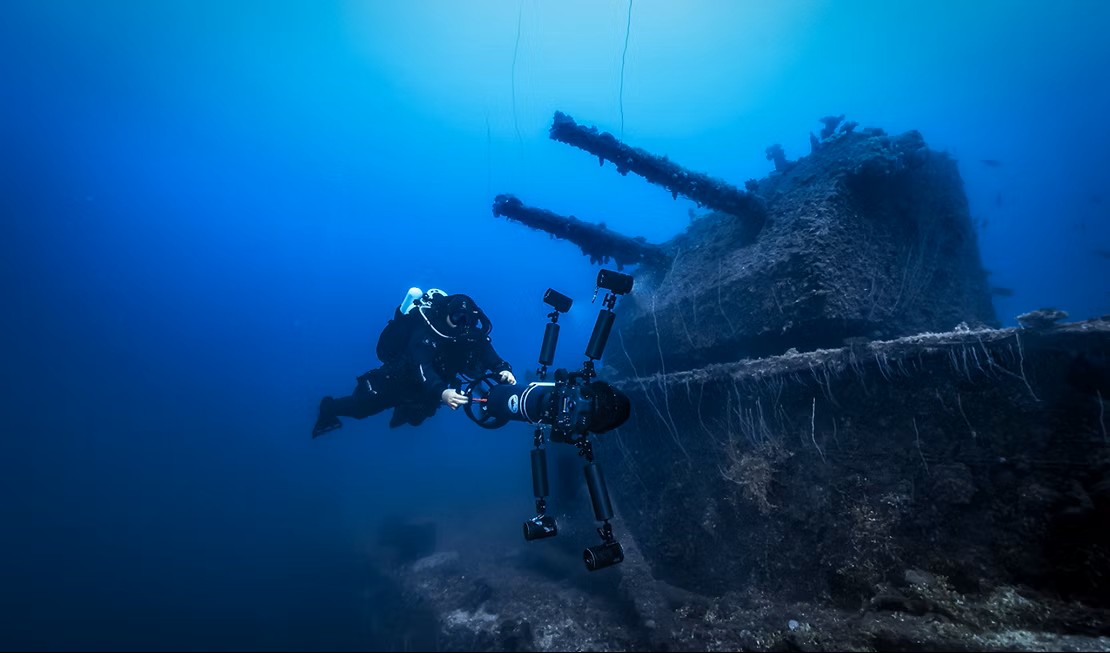
The Rabaul Mission: high-resolution sonar, photogrammetry and ROV inspection of priority targets, replacing inference with observation — wreck structures preserved in situ.
Guardian Sentry · Operational today
Continuous monitoring
Seismic, storm and satellite slick monitoring feeding live risk scores — so a deteriorating wreck is noticed before it fails, not after.
Where survey findings justify intervention — for example, the safe extraction of bunker oil from a compromised hull — that work is scoped as a follow-on phase with regional salvage specialists, under the consent of the coastal state and, where appropriate, the flag state.
What success looks like
We hold ourselves to the same standard our platform holds wrecks to: what is delivered is stated as delivered, and what is a goal is stated as a goal.
Wrecks assessed to date
Regions under continuous watch
Tonnes of oil & fuel at stake globally
The goals your support advances
- Keep the oil in the hull — or capture it safely — measured wreck by wreck, starting with the Rabaul portfolio.
- Give every Pacific coastal state a risk-ranked, continuously monitored picture of the wrecks in its waters.
- Set the precedent: a repeatable, consent-led blueprint for managing hazardous wrecks worldwide.
What sponsors receive
- Recognition across the mission's reports, platform and media output, at the agreed level.
- A documentary programme, currently in development, that positions partners inside a genuinely historic story.
- Direct access to mission briefings and the people doing the work.
Engagement tiers
Indicative shapes — every partnership is scoped individually with a benefits schedule agreed before commitment.
Supporting
Sustaining the watch
- Partner recognition on the mission site
- Quarterly mission brief
- Invitations to mission briefings
Strategic
Funding named capability
- Named sponsorship of survey targets, equipment or data-layer upgrades
- Tailored reporting on the funded workstream
- Early sight of publications and mission findings
Flagship
Partnering the programme
- Co-branded mission and documentary programmes
- Advisory participation
- Joint impact reporting
Sponsorship FAQ
Straight answers to the questions partners ask.
Why sponsor Project Guardian?
Because this is a rare thing: a preventable environmental disaster with a working, operating response that needs scale, not invention.
- Real outcomes: your support funds survey days in the water, monitoring coverage, and published methodology — all inspectable.
- A story worth being part of: war graves treated with respect, oceans protected before the spill, governments equipped to act.
- A precedent: the blueprint built here is designed to be repeated in other waters, by other nations.
Who does this work reach?
- Coastal-state governments, port authorities and regional environment programmes using the platform directly.
- Development banks and insurers for whom wreck risk is a material assessment factor.
- The scientific and maritime-heritage communities, through published methodology and case studies.
- The public, through the documentary programme in development and mission media.
How will our contribution be used?
- Phase 1 — Intelligence & prioritisation: assessment coverage, data-layer upgrades, methodology development.
- Phase 2 — In-water validation: the Rabaul deployment — vessel time, ROV and imaging operations, expedition logistics.
- Guardian Sentry — Continuous monitoring: keeping the seismic, storm and satellite watch running year-round.
Funds can be directed to a named workstream, and the funded work is reported against it.
What happens after we commit?
How do we get started?
Be part of making them safe
Request the sponsorship prospectus, propose a focused collaboration, or ask us anything about the mission. Institutional and sovereign audiences: see Engage with us.